Showing posts with label Places. Show all posts

Remembering East Pakistan; Part 2 – Ankahi Hi Reh Gayee

“Why can’t we put it behind us, this morbid angst over East Pakistan?” we both wondered. “Pen your thoughts, Samina” he suggested, “I wo...


“Why can’t we put it behind us, this morbid angst over East Pakistan?” we both wondered. “Pen your thoughts, Samina” he suggested, “I would love to read your take on it”. Misguided encouragement from friends is what got me here, blog-monkey on my back, in the first place and here I sat once again with my neck in the monkey’s stranglehold and my head reeling from that annoying, familiar buzzing sound. It happens when I have conflicting, crisscrossing thoughts about a subject that raises its question-mark-hat wearing head and refuses to vanish into thought-hell forever. 

The debate started with a comment about “the great leader” Zulfiqar Ali Bhutto. “What was great about him?” I asked.  The usual protestation followed; scholarly, international stature, honest, popular, Islamic summit, nuclear capability…and finally “he was a darn sight better than this sorry lot.” Had to agree there; “Even Ali Baba Chaalees Chor would be an improvement over these dakoos” I thought with disgust. But, regardless of the abysmal standards we suffer now, it was my turn to object. “He stole an election!” I reminded, “He didn’t win, Mujibur Rahman did. How was he any different from these thieves?”. Some agreed of course, others continued their harangue along two different theories; it was the Army not Bhutto, and Mujib’s 6-point agenda was anti-state. “Not true!” I contested. “It was the Army AND Bhutto, and Mujib’s demands were not anti-state, simply anti-West Pakistani fascism”.  The conversation was not progressing well.  Disgruntled and disappointed, we looked this way and that, decided to nurse our angst rather than release it, and sulked away into our corners. 

I have arrived at the understanding that two obstacles stand in the way of introspective reconciliation and peace.  In the memorable words of Faiz…

Un se jo kehney gaey the Faiz jaan sadqa kiye
Ankahi he reh gaee woh baat sab baaton ke baad

The truth remains untold; an apology remains untendered. Until the two are addressed, the ache in the nation’s heart about East Pakistan will not diminish.

The 1970 elections were memorable for several reasons. It was the first such national event to be transmitted live by PTV.  From an entertainment perspective, the content and quality were tops, harbinger of future possibilities in mass communication. A charming and talented young girl, Tahira Syed, was launched as were several other promising young Pakistanis exceling in various aspects of the production process, a collective that had already started to lift PTV head and shoulders above its regional counterparts.  I was 9 years old and captivated by 24x7 song and dance entering our living room for a few days. It irritated me that a Runa Laila number would be distastefully stopped to report a winner I didn’t care about, by a vote count I didn’t understand, in a dusty Pakistani town I didn’t know.  Years later I realized that the entire country shared my opinion; music and drama were the real McCoy, election reporting an unnecessary digression.  

Having grown up on martial law, the nation tip toed around the promise of civilian rule and democracy, pretending not to notice. Like an adolescent awakening to adulthood, we were expectant about possibilities but fearful of severing controlling ties. In wisdom and maturity, Pakistan and I were the same age – 9 going on 10.  

Sheikh Mujibur Rahman, erstwhile student leader and freedom fighter in British India, a member of the Quaid’s Muslim League, a highly credible and charismatic Pakistani politician, led his Awami League to an emphatic win with 160 Parliamentary seats against a modest 81 going to PPP and insignificant numbers to lesser parties. Even if Bhutto knitted together a coalition (a trick his daughter had to master years later), he could not beat his East Pakistani nemesis. In a just and fair world, Mujib would have been invited to form government and Bhutto would sit in opposition awaiting the next opportunity to compete. But Mujib’s ethnicity and 6-pointer rankled the establishment, both political and military, and creative delaying tactics were tried to disrupt his support base and break his resistance.  The strategy was shortsighted and proved damning. 

Not long before, my family had returned from a year in Iraq where Abbi and his contingent of combat pilots, amongst them some decorated East Pakistanis, trained their Iraqi counterparts. Now, Abbi was enrolled in PAF Staff College, Drigh Road and was often away from home on study tours.  Ashi was born during one such, to China. Our East Pakistani neighbors, a PAF doctor and his wife, helped Ammi through the process and Auntie Hasina, wife of Uncle AG Mahmud (later Chief of Bangladeshi Air Force) watched over my brothers and I while Ammi brought Ashi into the world. My parents were a popular PAF couple and had many friends. Our world did not prioritize ethnicity or blood relations. Our world was the Pakistan Air Force; everyone within it was family regardless of any other characteristic or definition. 

Then, evil was perpetrated by political leaders who chose to be divisive and military leaders who proved to be incompetent. Bhutto, spoilt child of martial law, ignited suspicion and disharmony while Yahya, modern day Nero, played the fiddle as Rome burnt. Together, they gifted the nation with a slogan so abominable - “Idhar Hum Udhar Tum” – that to this day it threatens our provincial harmony, rendering it threadbare. 

Soon it was 1971 and the wound of mistrust, salted by military heavy-handedness and peppered by political propaganda, festered and burst. 

A highly respected Punjabi Army officer who served in East Pakistan during the war and refused to speak about it despite his 3 years as PoW in an Indian camp, once stated in muted revulsion “There were so many dead that even the dogs would sniff and select the freshest offering.” He would say nothing more. A Pathan friend of Ammi’s maniacally related the traumatic story of hiding her children and feeding them toilet water for days, for survival until the Army rescued them. A Bangladeshi friend recalled his father’s household staff being stripped naked and slashed to death, by roadside gangs wielding machetes, as they hurried to refuge in a Dhaka slum. Extreme terror was experienced by both sides. When madness prevails, sanity tunes out and joins the mob. 

Theories abound about the scale of genocide in East Pakistan and how much earlier than the formally declared war it began. “No, no…it wasn’t millions. Arrey itney martey to peeche kaun reh jata?” said the armchair analyst while replenishing his pipe and reaching for his drink, “The Army had neither the manpower nor the ammunition.  Perhaps a mere few thousand, bas!”. I was aghast. “A few thousand – mere…bas?” I choked on my words. “Stop playing naïve my dear, you know the game. It was war…both sides played havoc” he rebuked me while inhaling nicotine and looking satiated. “Bilkul” piped the wife, “and what they did to poor West Pakistani families and businesses….those Mukti Bahini monsters!” as tears welled up in her mascara-laden eyes. Duly admonished but stubbornly spirited, I picked my jaw up off the floor and tried again. “How can you compare the destructive power of an Army, one of the largest in the world, against a rag tag mercenary force no matter how well supported by enemies?” I objected, “and how can we possibly justify the annihilation of our brothers, our own countrymen? Jang dushman se hoti hai, apnon se nahin.” Theatrically, I rested my case, albeit that last sentence leaving a question mark in my own head.
   
The sage, for he was that, threw me a quizzical glance. “My dear, it was the Army that underestimated the rag tag mercenaries, don’t you think?”. Hmm, I had managed to entangle myself and he was amused. “And have you not learnt from history that brothers are the worst, and most eager, of enemies?”. Check-mated was I.

State sanctioned massacre must never happen, no matter the provocation. The Mukti Bahini may not have seen the light of day had “Masawat” been maintained between provinces.  Once born and a threat to sustainable peace and harmony, “Hikmat” with “Raham” should have been extended to the wronged community. Genocide and separation may have been avoided had post-election choices remained “Halal” and the winner granted “Haq”. And now, when irreversible damage had been inflicted upon both sides, “Muafi” should be requested and offered; not one murmured sidelong by a military dictator but a “Ba-izzat” one, nation to nation. 

In the East Pakistan conflict, truth was the first victim, followed by moral courage and the wisdom to repent. We are created in His image, yet we shrank from manifesting His most beloved characteristics, without inhibition, as He invariably does. 

My Bangladeshi maid has been with me for eight years. Her kind disposition and efficient ways have brought order and comfort to my home. Her community is dirt poor and her personal circumstances extremely unfortunate. She is young and has virtually no knowledge of 1971 except that it was the year of “Azaadi”.  Mine was the first Pakistani family she became acquainted with and because our mutual terms are pleasant, she seems to consider all Pakistanis good people. She has taken to “Khaadi” suits, mangoes, Urdu and Zozo as if she was born to embrace them. I imagine if she received a truthful narration of 1971 she would prefer to dismiss and not believe it. At the very least, she would remove my family from the equation convinced that none of us could ever be linked to such brutality. It is entirely possible that men from my extended community may have maimed or killed her people. Certainly some young men of my family were killed by the Mukti Bahini or died in action during the war. I would rather she did not know….I would have no answer for her except “Im sorry”. 

She has bought land and built a house in her village, contributed to the mosque there thus elevating her family’s status, lives comfortably with my family and travels often to Bangladesh.

In a cowardly, discreet way, thru her, I apologize to my East Pakistani brethren every day.

Remembering East Pakistan; Part 1 – Woh Humsafar Tha Magar ….

Kabhi yeh haal ke dono mein yak-dili thi bohot Kabhi yeh marhala jaisey ke ashnai na thi From Nasir Turabi's ode to the painful Eas...


Kabhi yeh haal ke dono mein yak-dili thi bohot
Kabhi yeh marhala jaisey ke ashnai na thi
From Nasir Turabi's ode to the painful East-West Pakistan breakup in 1971

I was to visit Bangladesh for the first time. It was part of the geography I managed work-wise, and because economic indicators for the country were bullish and growth was imminent, I was tasked to increase our presence and business there. The visit, and dozens thereafter, became a cherished life experience for me.

Razi’s departure had rendered me a liberated, albeit hesitant, “civilian” (oh, the price one pays for freedom….but that’s a subject for another blog entry). Now there was no constraint of security for me as an extended “military personnel” (why a single individual is referred to as “personnel” in fauji-talk is beyond me, even if it is less dehumanizing than “human resource”), so I could travel to countries which earlier constituted sensitive, if not forbidden, destinations. Amujani was excited and reminded me repeatedly to visit the house in Dhaka cantonment that she had lived in. Abbi was nostalgic; “Look up my buddy AG Mahmud, you remember Auntie Hasina right?” and “Check up on Khandkar Sb, what a great officer he was”, and finally “I wish Bashar old chap were still alive, he would be so happy to see you… what a tragedy”. This last referred to AVM Khademul Bashar who, in 1965, was Abbi’s squadron mate and our neighbor in Mauripur, and whose daughter Shampa was my bestie. Uncle Bashar died in an air crash later as Chief of Staff of Bangladesh Air Force. Abbi had many Bangladeshi friends from their shared PAF tenure, and he and Ammi remembered them fondly. “I’m travelling for work”, I reminded my excitable household, “It’s not a holiday”.

For all the buzz at home about my first trip to erstwhile East Pakistan, a land my elders had loved, only Ammi remembered; “You’re landing on December 16th, beta. It’s Victory Day in their country. Ehtiat karna.” With this statement of fact, punctuated with an understated note of caution, Ammi conveyed all that remained unspoken; betrayal in love, wounds of war, anger and regret, and intense sadness over separation. It was buried, but it festered. All became quiet. I felt like the child of a contentious divorce preparing to visit the other parent.

It was indeed Victory Day and Bangladesh TV vociferously informed me of it as I settled into my hotel room. Resounding declarations of loyalty to the country with delightful renditions of Tagore’s uplifting Amar Sonar Bangla reminded me of state television back home; BTV, after all, was a child of PTV hence amusingly similar. The message, however, was starkly contradictory. For the first time in my life I heard the words “murderous Pakistan Army, “Our enemy Pakistan”, and (God forbid) “Death to Pakistan”. Horrified, I watched grainy footage of aggressors hunting down and killing scores of unarmed men, women and children. Since 1971, my fellow countrymen and I had been fed a nauseating diet of “Idhar hum, Udhar tum” by the establishment, portraying Mukti Bahini as the aggressor and Sheikh Mujibur Rahman as the betrayer. I had never fully bought into it, but I had also not ventured in search of an alternate. Discovering it while a guest of the brethren we had butchered was sobering.

The doorbell rang and I exited my reverie. The guest relations officer was returning my passport after having registered it for security with Police; standard procedure during Sheikh Hasina’s rule, graciously waived during Khaleda Zia’s. As he handed it over with a smile and another word of welcome, he seemed unruffled by its ominous origin. “He’s too young to remember” protested my paranoia, “he doesn’t know you’re related and you killed his parents!”. That night I hid under the covers, dreading the unavoidable experience of facing modern day Bangladesh as the nth generation of Pakistani military.

The next day, and the subsequent week, were a revelation. My hosts, business partners of my company, took to my strategies for growth like ducks to water. No one from our industry had acknowledged their country’s potential in the field as I had, and they were not about to miss this opportunity to participate, collaborate and contribute. Their revenue base was tiny and, all told, it would remain smaller than their neighbors’, but their mint-shiny enthusiasm was contagious and I was enchanted. For five days, we used every hour between breakfast and dinner to brainstorm ideas, meet customers, devise strategies and agree on execution models. In the end, as I prepared to depart, we had a business plan, they had an invitation to visit Pakistan, and I had a fresh perspective on a complex, love-hate relationship.

From vendors on the street to hotel clerks, from senior executives at customer organizations to young IT enthusiasts, I experienced no hostility, and this surprised me immensely. There was, however, much curiosity. Everyone was surprised that I was Pakistani and not Indian, and everyone attempted to converse with me in Urdu. The neatly dressed young man who chauffeured me asked, shyly “Madam, hum suna Islamabad bohot sundar?”. The COO of a bank extended our 40 minute visit to 2 hours asking about ex-colleagues at UBL where he had trained and worked under Agha Hasan Abedi, “the god of banking” as he called him. (It turned out I actually knew a couple of them!). A business tycoon who wished to invest in a startup scribbled a paper-napkin-map of Islamabad’s F-6/2 sector precisely identifying two plots which he had abandoned when he fled to Bangladesh. “You had two?” I asked, incredulous, “each 2,000 sq yds? Wow!”. “Arre baba, koi nahin leta tha…sab apna abai shehr mein invest karta tha. It cost me peanuts…best investment I ever made, until….” And he drifted off. Of course, it was not possible to glide through a week without a single whack on the wrist. “My dad was a freedom fighter”, said a young man during a Q&A session not meant for the topic. “He told me that jute exports paid for Islamabad”. The young man’s casual accusation left me grasping for a response, finding none. “Unko Islamabad se patsan ki khushboo aati thi”, his Urdu diction was perfect, his smile disarming. Oh boy! I stuttered and stumbled, and changed the subject. Local colleagues tried to help me recover and, over lunch, we ambled into a candid conversation about a discomforting subject. That it ended on a mutually appreciative note is credit to their magnanimity and, possibly, my sense of humor. A friend who fancied himself a political activist told me his story. He was enrolled at Dow Medical College, Karachi in 1971 and remained in the thick of political strife between Awami League and PPP until his dramatic departure for Bangladesh, his academic ambitions shattered. His account of atrocities committed even before war was officially declared brought tears to my eyes. My account of the shahadat of Pilot Officer Rashid Minhas at the hands of the PAF betrayer Flt.Lt. Matiur Rahman surprised him. “Betrayer, ghaddar?” he exclaimed, “but he was a patriot. He received the highest military award of Bangladesh”. “Hmm” I responded, “maybe he and the Nishan e Haider awardee of Pakistan can talk it out in heaven; they seem to be together again!”. Heroes and villains…one man’s is often not the other’s.

In the end, I discovered that, despite the injustice done to them, Bangladeshis are not bitter about 1971 like we are. It is rather like 1947; the Indo-Pak partition does not occupy my thoughts the way it does my Indian friends’ with whom conversations often end with “Kya yaar, saath hote to acha hota!”. It is my belief that the one who leaves moves on while the one who is left agonizes and pines, as we do for East Pakistan.

More soon…….

Image Credit: thousandwonders.net

Notes from Erbil – Part 3 (The Country)

Tigris from Erbil to Sulaimaniya The first time I was in Iraq I was 8 years old, between 1969 and 1970. My father led a group of PAF pil...

Tigris from Erbil to Sulaimaniya
The first time I was in Iraq I was 8 years old, between 1969 and 1970. My father led a group of PAF pilots to train the Iraqi Air Force. They flew from Habbaniya Air Force Base but we lived in Baghdad a few miles away. The Pakistani pilots’ squad commanded great respect in military and diplomatic circles. At the time, Saddam Hussein Tikriti was a young army officer whose devilish ambition had not yet been inflicted upon the nation.

I recall we lived in Al Mansoor Building on Al Yarmuk Street.  Our high-rise apartment building was fully air-conditioned, had high-speed elevators, and a brightly lit, immaculately clean, 24/7 grocery store on the ground floor. To an 8-year old Karachiite, it was Intercontinental, Bambino and Saddar morphed into a combined, exciting, modern fairyland.

Every morning, at the crack of dawn as the Air Force vehicle arrived to transport the pilots, another vehicle also arrived and dropped off a box full of freshly baked loaves of bread at the store entrance.  There the box lay, unlocked and unmonitored, as tenants stepped out in their PJs to pick one – or two – up until the stock was depleted. No payment, no stealing, no rush. I suppose the grocery store paid the bakery…I always wondered but never found out how the transaction was secured. Ammi was an early riser and one of the first to fetch the warmest, most delicious bread I have ever had. On weekends, my brother Haroon and I were tasked to bring a loaf up. It was Ammi’s smart tactic to get us out of bed early. Haroon and I also discovered “Mota” ice-cream at the grocery store. It proved a worthy replacement to our favorite “Polka” and Ammi generously treated us to it most evenings. There was a girls' college adjacent to our building and my favorite past time was to watch the girls get on their bikes to ride home just when I was getting off my school bus.

In 1969, Baghdad was a modern city, ahead of others in the region. It must be rubble now. Certainly some of the heritage sites my parents loved to take us to, like the ninth-century Samarra Minaret not far from the city, have been blown off the face of the earth. If bent upon evil, one generation is enough for destructive forces to prevail.

Samara Minaret
 I am in Iraq again, over 40 years later. "First time in Iraq Madam?" the immigration officer inquires. "No" I reply pensively, "I was here once before, when I was 8 years old". He doesn’t bat an eye. "Welcome Back, Madam!" as if the decades were a mere few days. He is too young to have experienced a stable, peaceful and happy Iraq. I am not and, subconsciously, have come seeking it in Erbil since my travel security refused to allow me to step into Baghdad.
Erbil Airport
Erbil, part of the federated Kurdish territory, is not rubble, quite the opposite in fact. I land at a small but spotless, modern airport where I am picked up by the hotel transport. I am driven to the Erbil Rotana located on a quiet suburban street. I am sure I am missing something, whatever remains hidden from a short term visitor, but this is a far cry from Fox News fare. I have two workshops with customers in Erbil, and a number of meetings in Sulaimaniya which is a four hours drive away. I am told we shall be driving along the border with ISIS controlled Kirkuk. “It’s quite safe, Madam” the driver assures me, “If we are careful”, whatever that means. I’m game, though, looking forward to crossing the Tigris on the way, meeting young Pakistani professionals who are helping to establish telecom operations in the city, breaking bread with Iraqi customers with hopes of experiencing a long lost but cherished taste. The night before, as we chat on Whatsapp, I say too much about my scheduled adventure. Happens every time! The kids and Ashi, my goodwill stalkers, panic and urge me not to venture too far from the hotel, to forget about Sulaimaniya, to steer clear of anything remotely associated with “those people”. “Log martey hain wahan…koi zaroorat nahin hai jaaney ki…tell them to come to the hotel to meet you!” Muns pleads and others concur.

I am acutely conscious that this is what travelers are told by their fretful families when they venture into Pakistan. So, in solidarity with ill-governed countries and their misunderstood people,  my own amongst them, I am not about to pay heed to warnings. 

The weather is cold, the hills are undulating and green, the landscape somewhat less fetching than the lush green Margallas but exhilarating nevertheless. We cross the winding Tigris at a narrow point, stopping along the way at several points for security checks which are unexpectedly cursory and superficial. It is inconvenient but not unpleasant. Sulaimaniya is a bustling town with several regional business headquarters. I am surprised to find several Pakistanis who live here with families and feel no fear or insecurity, unconcerned about the war raging a stone’s throw away. Either they are in denial, I think to myself, or they have unraveled the mysterious strategy of terrorism whereby safe havens are pre-defined and kept thus.

Either way, Iraq is in the eye of the storm and  it suddenly strikes me that people live here....it is home to them, these cities are part of a country. To destroy them, like Baghdad, their human face must be stricken from the conscious. Reality TV must present them as morally destructible - land, culture, heritage, people, dreams and aspirations all camouflaged in a cloud of dust rising from rubble - so that 24/7 viewership is able to dismiss them as sub-human, unworthy of consideration, respect or mercy, and not suffer any guilt over the collective sin of violation and destruction.

There is nothing I can contribute to change the fate of this country. After all, what have I been able to do to change the fate of my own? But while I am here I intend to appreciate and respect the land and the people. I will tell them they have a beautiful country and that they must be proud of it.

It is all I ask of people who visit mine.

Koh Qaaf Ke Parizaad (Fairy-Children of The Caucasus)

Two weeks ago, I had the pleasure of visiting Georgia or, more precisely, the city of Tbilisi.  Uncharacteristically, I deviated from my ...


Two weeks ago, I had the pleasure of visiting Georgia or, more precisely, the city of Tbilisi.  Uncharacteristically, I deviated from my airport-hotel-office-airport routine and took some time to venture forth and learn about the city’s rich history. A single day is not enough to discover a world (cities are that – worlds in themselves) but if one watches, listens, smells and feels generously and with compassion, one may imbibe the spirit of the place if not its entire soul.

Google and Wiki have abridged life’s adventure. What can I tell you about Tbilisi that they have not already condensed, scripted, de-humanized and secured? You don’t need to know that Georgia was part of the Soviet Union, that it now aspires to become a member of the EU, that it has gorgeous, lush green mountains.  But plain facts have never interested me any way.  I’m a seeker of the obscure, an explorer of what was lost, a traveler in time to the glory – or the misery – that was. 

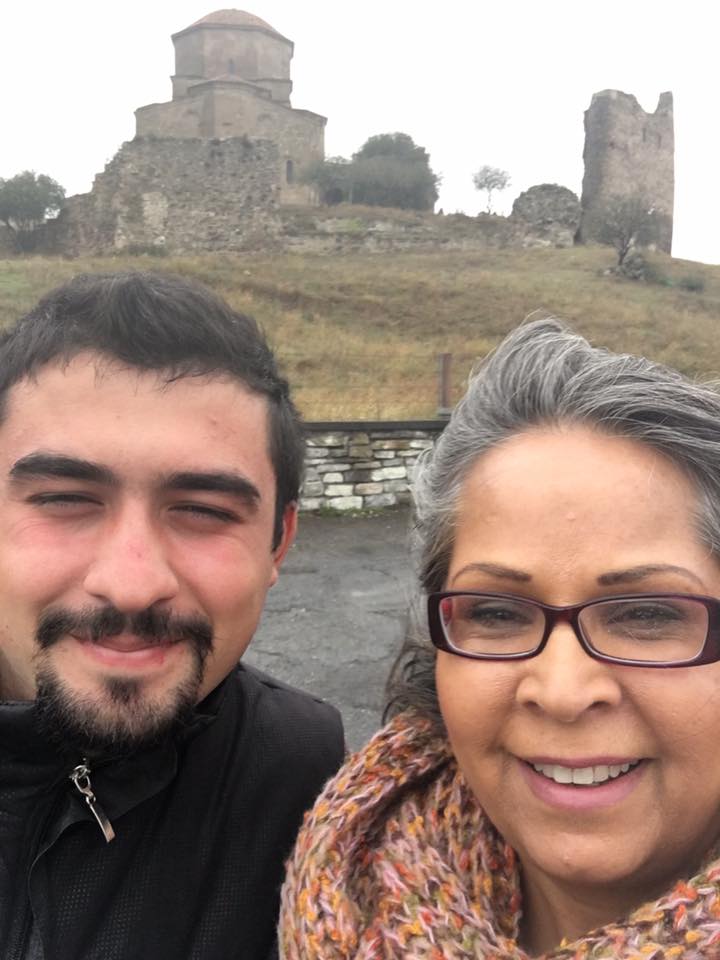
My narrative is also highly contextual.  Sometimes without meaning to and often against better judgment, I juxtapose experiences against that which defines me - Pakistan. “Tbilisi is like Bhara Kahu!” I exclaim as we wind our way up the hill to Jvari Monastery. “5th century AD? Nice! Taxila is 6th century BC, my home is 45 minutes from it!” I name-drop unabashedly. “No crime? You mean zero? Like I can leave my laptop right there, lying invitingly on the back seat? Hmm…well….not where I come from…I’ll just carry it with me.” I mumble.  My instinctive but tasteless “mine is better than yours” game shows me up as my world comes up short on several counts.


My fellow traveler named – what else – George, is a 22 year old Autocad expert who turns tour guide over weekends to earn extra bucks.  He has a rock band, lives with his dad and stepmom (gets along well with her he tells me), and doesn’t pack an umbrella even though he knows it rains a lot in Tbilisi, as it did on our day. “Good tour guides carry umbrellas George, never leave home without one” I admonish him as I would Billu.  Unlike Billu, George does not argue.  He apologizes for the slip up and promises to drive us right to the Church entrance. We are on a Monastery tour and he is on first name basis with all the priests in all the Churches, so they will not mind if we drive into the main courtyards. “Wasta” applies everywhere, even with Orthodox Churches. I never say a word about my own thoughtlessness of not bringing a hotel umbrella. I’m like that, I just don’t own up to my mistakes – very Pakistani.


George has no idea what Bhara Kahu is or where Taxila exists, but he smiles graciously, acknowledging my chatter. By the end of our journey, as we sit down to his choice of meal - authentic Georgian cuisine - we are friends and he is curious about my world. “Pakistan? Oh, India!” and I wonder if when my Indian friends travel they are confronted with a similarly exasperating comment “India? Oh, Pakistan!”.

My four days in Tbilisi do not amount to a substantial tour, but they were enough to be captivated with the land and the people.  Here are a few things you may not know about Georgia. I haven’t checked but I’m hoping these are original data points which have not yet been Googlized.
 
1. As a child, my staple reading diet was all that was connected with Koh Qaaf, the Mountain of Caucasus. Ammi told me that all fairies originate in Koh Qaaf, and that they were all beautiful.  Abbi would describe how a Dev’s life was held in a parrot; kill the parrot, kill the Dev – otherwise do what you may but the evil Dev would not die! Once, Amir Hamza married Koh Qaaf ki Shahzadi. I wondered a bit about the growing number of wives my favorite hero was acquiring but forgave his recklessness in view of his excellent choice of the latest.  I wanted to be Koh Qaaf ki Shahzadi even if it meant being carried off by the evil Dev whom Amir Hamza would kill via proxy-parrot, and eventually ending up in an Arab harem.  Feminisim came to me late.

2. Georgia is a proud member of the Caucasus region. So it is Koh Qaaf of my childhood – how delightful is that! Georgians do not appreciate being referred to as Central Asians or Russians and insist that they should be called Caucasians.  Ironically, most of them express surprise when told that the world defines “White” people as Caucasians, that our international woes may be born of the divide between Caucasians and those who are not. To Georgians, Caucasian is simply their ethnic identity and not a declaration of superiority.

3. George is to Georgia what Lee is to Korea, what Wong is to China, what Zaib is to Northern Pakistan. Every second Georgian male is either Giorgi or George.  If you are in Naran-Kaghan and you shout “Zaaaaiiiiibbbb”, most of the street vendors will drop their chores and mob you with “Jee Baji?” because they are some form of Zaib – Alamzaib, Shahzaib, Jahanzaib etc etc.  So it is in Georgia. If you don’t know the name just say George; there is 80% chance that you got it right.

4. Georgia is known for its sparkling water “Borjomi” which it exports to many countries, especially Russia where it has been the preferred choice since Russia discovered the springs in ski resort nestled in the Bakuriani mountains.    “The sweetest spring water in the world” they claim and, factual or imagined, I believe I tasted the sweetness.   The irony is that while Borjomi is proud identity to Georgians, it is now owned by the Russian Alfa Group.  “The Russians they bought it……&$%F@$kd*…..!”

5. A simple question like “So, what language do you speak…Russian?” could cause a mild avalanche, so never say “Russian”.  Georgians are anxiously trying to live down their years with the Soviet Union and nothing irks them more than disrespect for their language which was sidelined in favour of Russian during their dark years.  It’s a phonetic language (meaning you write it as you say it, not like English where you may write one sound and utter altogether another). It has between 30 to 40 alphabets (depending upon which region you may be referring to) which gives them a representation of pretty much every sound there is to make.  Written, it looks to me like Thai script.  Spoken, many words sound rooted in Sanskrit, e.g. kidney beans are “lobiani”, “kachapuri” is a cheese-roti/puri, but Georgians insist that their language is rooted neither in Latin, nor in Arabic or Sanskrit.  My colleagues at work proudly exhibit their command over complex sounds such as “Kh” and “Q” the Urdu way.  “You will fit right in with the Pathans” I tell them. Predictably, they smile in response – as if they believe similarity with a Pathan is a good thing.

6. In Tbilisi, there are some beautiful churches commissioned by a 12th century monarch. Her name was Tamar and she is known as the only “female king” of Georgia. If you search for her, you will find her listed as “Badass Queen” who was crowned as a teenager and whose father taught her to “unflinchingly decapitate any of the douchebags who tried to f… with their royal line”.  Lesson learned; dads can be awesome mentors, being badass is a good thing, and girls are super heroes who can do anything.

  
7. I didn’t find Georgian food appetizing.  Growing up on what is arguably one of the most multi-layered, refined cuisines in the world – South Asian (yes I could make a case for it even against French, Mediterranean or Thai) – I am not easily taken by what many nationalities may consider heavenly food. Georgian food is about cheese and pork, neither of which I find compelling. As cheeses go, Georgian cheese would come in behind many others, and as for pork, well, I’m Muslim so while I may commit the worst sins in the world eating pork can not possibly be one of them. Consequently, when George suggested we sample some “Khinkali” I responded “sure, as long as it has no pork, ham or bacon in it”.  George was pleased; “No problem. We don’t eat those, we eat pig! You eat pig, yes?”  We had to settle for safe stuff like cucumber pickle, tomato salad, cheese bread and Borjomi water.    

Nakhvamdis Georgia…until we meet again and find Khinkali without pig.

Notes from Erbil – Part 2 (Yara the Water Carrier)

  The problem with solution sales cycles is that they can be endless.   A question leads to a suggestion which brings forth a recommend...

 
The problem with solution sales cycles is that they can be endless.  A question leads to a suggestion which brings forth a recommendation which further leads to a workshop which generates more questions which…..well….you get the drift.  Sometimes, miraculously, the client “gets it” and thereon the cycle progresses swiftly.  Other times, one finds oneself in a vicious circle of recurring engagements, nightmarish and inextricable.

I have a bad feeling about this one. The familiar signs of expectation, acceptance, participation, excitement, and achievement were simply not forthcoming. Somewhere in the sequence I lost my audience and am furious with myself.  I should have performed better.   My colleagues are generously trying to cheer me up but it’s not working; we are collectively dejected. “I have failed” I wallow, “Short of a sign from God, nothing can brighten this miserable day”.  My colleagues are exchanging furtive glances; “A bit over the top, isn’t she?” I can hear them thinking.  Little do they, or I, know that a proverbial sign-arrow has just been released from God’s blessing-bow, and that my dark skies are about to receive a silver lining.

As we shuffle into our seats at The Cedar Tree, a young girl scurries up, bends over the table to wipe it down, then straightens up while tucking the washcloth into her apron, and finally stands poised with pen and paper ready to take our order. Her attitude is cheerful, her conduct one of deference with dignity. She is short and slim of stature, barely 16 or 17 years old I imagine.  As she introduces herself in lilting Arabic and halting English, her spontaneous smile spreads uninhibited across her face as a child’s often does.  “Marhaba bekum fi mutamin Sayyiditi wa Sayyidi….I am Yara, please to take order”.  Other than the fact that she is Omran’s employee, which by definition lends itself to all kinds of stories, she is unremarkable…except for her eyes.  They have captured the travelling smile and are holding it securely, but just beneath their brightness lurks a restless energy agitating for release. She seems oblivious to it and goes earnestly about her chores, but there it lingers like a sinister secret accentuating her otherwise cheerful bearing with an element of longing, as if she remains incomplete, unfulfilled.

Suddenly, and fiercely, she swats a fly that lands in my friend's plate, dead. I expect Yara to apologize profusely. She doesn’t.  In fact, she seems extremely pleased with her conquest and, holding the plate up, is now observing her victim at close proximity. She bursts into an infectious giggle and soon has all of us laughing too.  Promising not to swat another one in our vicinity, she takes away the compromised plate of food to replace it.  She should be fearful of reprimand, but this is Omran’s world….one does not sweat the small stuff here.

Yara’s story is infinitely more calamitous than a mere fly-swatting incident, and while one can understand her dismissal of minor mishaps, it is difficult to comprehend her joyful demeanor along the way.  Omran the proprietor, storyteller, self-appointed protector and rehabilitator narrates her story.

Yara is Syrian.  “I am the water carrier” she quips, “it’s what my name means.” In a country suffering one of the highest water poverty levels in the world, her name conveys prosperity, hope and abundance and is, therefore, very popular. True to her name, Yara has carried water for her family since childhood.  Her siblings, Ameera and Nabil, and she had made a game of it as they trekked to and from the water filtration plant constructed by the municipality, to fetch water.  For a few hours every day, the faucets spewed forth sufficient water to fulfill the community’s needs, albeit inadequately.  The rest of the day they remained miserly and dry.

The filtration plant was soon claimed by ISIS and the community’s access to it became greatly limited.  The day the unit commander took Ameera away to be married to him, he offered Yara’s father unlimited access to the plant since they were now related.  Yara’s father rejected the offer and demanded that Ameera be returned.  The unit commander would have none of it.

Yara was just 12 years old and her parents feared for her safety.  After all, Ameera was not much older and they could not save her.  Those were particularly distressing days for Yara. She realized that one could do without things and still be happy, but to exist in a realm of insecurity and remain happy...this was impossible. Her parents were neither well nor wealthy so instead of attempting flight as a family, they arranged for 12 year old Yara to escape. She traveled with neighbors and relatives, successfully escaped ISIS and arrived in Turkey. At 13, she started working and sending money to her parents in Syria.  She wanted only one thing in life - to be with her family again. Had she made Turkey her permanent home, perhaps her dream would never have been realized.  But God’s blessing-bow was stretched and the arrow it launched took spunky little Yara from Turkey to Iraqi Kurdistan, Erbil specifically.  She was the most emaciated and destitute refugee to take shelter in the Grand Bazaar.  Old Omran was informed about her fragile state and he took her in, conjuring up a spectacular transformation yet again.  

Yara is 16 now, works at The Cedar Tree and has managed to bring her family to Erbil.  A frail young girl has been the savior of her family, and happy to be so. A spectacular transformation has occurred (take a bow Omran!). For someone fleeing ISIS, Erbil at the border with ISIS staring it down is still paradise. Yara shares the spirit of all immigrants – to be liberated from demons - but unlike others seeking a better life, all she wants is freedom from insecurity. “I don’t want to look over my shoulder all the time” she tells me, “I don’t want to be the unit commander’s wife.”  Her eyes grow restless as she speaks, and I recognize the darkness lurking within.  “I don’t know if I can bring Ameera here. She may be waiting for me.” Yara is incomplete, she remains unfulfilled – but Omran has coaxed her into a smile that lingers on her lips, climbs up her face and brightens her eyes.  Her generosity of spirit fascinates me.  I am suddenly released from my own demons, minor though they may be in comparison. 

I remain intrigued by Yara, captivated by her story. I will return to Erbil and eat at The Cedar Tree, if only to be sure that Yara is well, swatting flies and smiling all the way to her eyes. 

Image credit: Pexels stock imagery.Will post a pic of young Yara soon.

Notes from Erbil – Part 1 (Omran the Proprietor)

In the unexpectedly peaceful border city of Erbil in Iraqi Kurdistan, on a bustling side street of the Grand Bazaar, there is a quaint li...


In the unexpectedly peaceful border city of Erbil in Iraqi Kurdistan, on a bustling side street of the Grand Bazaar, there is a quaint little restaurant named, unimaginatively, “The Cedar Tree”.  Since most of my colleagues who service Iraq are from Beirut, after some initial haggling we invariably find ourselves at a Lebanese eatery.  This place is modest, the food is delectable, and the service prompt and pleasant.  One could take advantage of corporate travel perks and opt for up market fare, but sometimes the heart desires simplicity, the feet some respite, and the growl from deep within commands “sit down woman, eat!”.  So, The Cedar Tree it is on this particularly exhausting day.

Omran, the proprietor, is in his sunset years but has an elephant’s memory and remembers all his patrons.  As he sees me step into the restaurant, he hollers “Wallah, Thamina al Bakistan…Ahlan, Marhaba!”.  I have just concluded a five hour long strategy workshop with a client’s digital transformation team, young professionals scaling the competency and attention spectrum from utterly clueless and disinterested to reassuringly aware and attentive.  Workshops are grueling exercises. My nerves are shot, my ears still ringing from Arabic-English commentary, and my feet are throbbing to be released from their high-heeled confines. Omran’s resounding welcome shatters my senses but the warmth in it brings a smile to face. Despite my disgruntled state and regardless of the provisions about to be served, today’s Cedar Tree experience is a success even before I begin to browse through the menu.

Omran has another peculiar practice. It would go unnoticed except that, in character, he delivers a continuous and oft-repeated account of his mission and the lives that it touches.  He seeks out ragged refugees and employs them at his establishment.  The more disheveled, emaciated and miserable the candidate, the greater Omran’s motivation to transform the wretch spectacularly.  One would suspect foul play, perhaps exploitation under the guise of benevolence? Not so with Omran. He is a standup citizen whom the community respects and trusts, a grassroots leader of sorts. Of this one is reassured equally by restaurant patrons as by Omran himself.  Over the past year, I have been served by old men, hijab-clad mothers with toddlers seated at a corner table drawing or eating or just watching, teen-aged boys and girls, and at least in one case a special needs person who originally accompanied his brother but later proved he could operate independently and earn a living.  It was a proud moment for his brother but an even prouder – and louder – moment for Omran who considers this his greatest success as a self-appointed benefactor-change maker.

The Cedar Tree is well patronized, I have seen it quite full at most times.  But old Omran’s grand design to serve humanity comes at a cost.  With random staff changes, frequent out of budget payouts and general financial disarray, I doubt that it delivers any profit or is even sustainable as a business venture.  A corporate style due diligence would discover negative ROI and poor business practice. It would recommend that the CEO and management (Omran in both cases) be fired and better practices be followed. 

Erbil is shelter to thousands of refugees displaced internally from war-torn Iraqi territories as well as from neighboring Syria. The city is lodged between Mosel and ISIS-controlled Kirkuk, household names thanks to 24/7 war reporting (read reality TV from the comfort of your couch in your superficially safe middle class home). The demographics of Erbil have changed in a few years due to the dramatic shift of population, and public and private service providers have had to re-evaluate, re-strategize, and re-prioritize their plans and delivery. Erbil families have lost hundreds of members, army and police men and women, in the community’s gallant effort to protect their province from ISIS, which they have done successfully thus far. 

Erbil exists in the eye of storm, stable but at risk of destruction if elements of the equation become even slightly imbalanced. 

Against this sobering background and in comparison to insurmountable problems, old Omran’s relatively insignificant venture to rehabilitate a few, pales.  His earnest devotion to the cause has brought a semblance of well-being to a mere one hundred, maybe two.  It is nothing in the colossal tragedy that is Iraq.  But he soldiers on, undeterred in his purpose, unconcerned about the enormity of the challenge.    

Amongst the many stories Omran likes to narrate about those who have been saved, there is one he repeats most often; his own. In an endearing cacophony of Arabic-English which he considers his mastery of both languages, he has told me the story a number of times.

As a young boy, Omran migrated with his family from war torn Lebanon to Iraq for safety and better prospects.  They were a dismal bunch when they arrived in what was then arguably the most modern and progressive of Arab countries.  His mother was pregnant with his little sister, his brother was asthmatic and often unwell, and his father gave in to fatigue and depression early and died.  He and his mother took jobs washing dishes and cleaning tables at a humble little eatery; “in comparison to it, The Cedar Tree is Maxim’s!” Omran guffaws.  His baby sister lay quietly on a cot in the corner while his mother washed dishes, and he learnt languages, mannerisms and the trade while he cleaned tables, took orders and served meals. His brother’s health improved and he was able to join school.  Life did not offer them much better fare than what they had in their village in Lebanon, but it became comfortable and prospects for his brother and sister improved. 

The owner of the establishment where his mother and he were employed was a burly, hollering old man who had a peculiar practice to employ rag-tag refugees. People warned him that such presumptuous generosity would bring him no wealth, that he would be ruined in no time.  The old man never listened.

Image credit: The bread I ate looked just like this. This one's from the great eyes of Google since the old man was not too keen on getting clicked. Next time I see him, I promise I'll get one for you all.